Roof Maintenance Tips for Long Island Homes to Avoid Costly Repairs
Most Long Island homeowners do not think about their roof until something goes wrong. It is one of the most understandable maintenance oversights in homeownership, because a roof that is functioning correctly asks for nothing. No noise, no visible activity, no reason to pay attention. But roofing systems do not fail suddenly in most cases. They deteriorate incrementally through the accumulation of small, addressable issues that go unnoticed until one of them crosses a threshold and produces a leak, a ceiling stain, or a structural problem that demands immediate and expensive attention.
The good news is that consistent, informed roof maintenance prevents the vast majority of premature roofing failures and costly repairs. At Aaron Roofing Corp, we serve homeowners across Long Island with roofing services built on honest inspection and quality craftsmanship, and we offer free roof inspections specifically because we know that early identification of developing issues saves homeowners significantly more than it costs. This guide covers the roof maintenance practices that deliver the most protection for Long Island homes, specific to the weather conditions and roofing challenges this region presents.
Why Roof Maintenance Matters More on Long Island
Long Island’s climate creates a combination of stresses that roofing systems in more moderate climates do not encounter. The coastal location brings salt air that accelerates corrosion in metal roofing components including flashing, fasteners, and gutters. Nor’easters deliver sustained high winds that test every shingle seal and flashing attachment. Late summer tropical systems add intense rainfall and additional wind loading. Winter freeze-thaw cycling expands and contracts roofing materials repeatedly through each cold season, working fasteners loose and opening seams in flashing. And Long Island’s abundant tree canopy deposits organic debris that accumulates on roof surfaces and in gutters, retaining moisture and promoting biological growth.
The result is that a Long Island roof that receives no proactive maintenance will reach problems faster than the same roofing system installed in a more forgiving climate. The converse is also true: a Long Island homeowner who performs consistent roof maintenance extends the functional life of their roofing system meaningfully and avoids the repair costs that develop when small problems are allowed to compound through seasons of weather exposure.
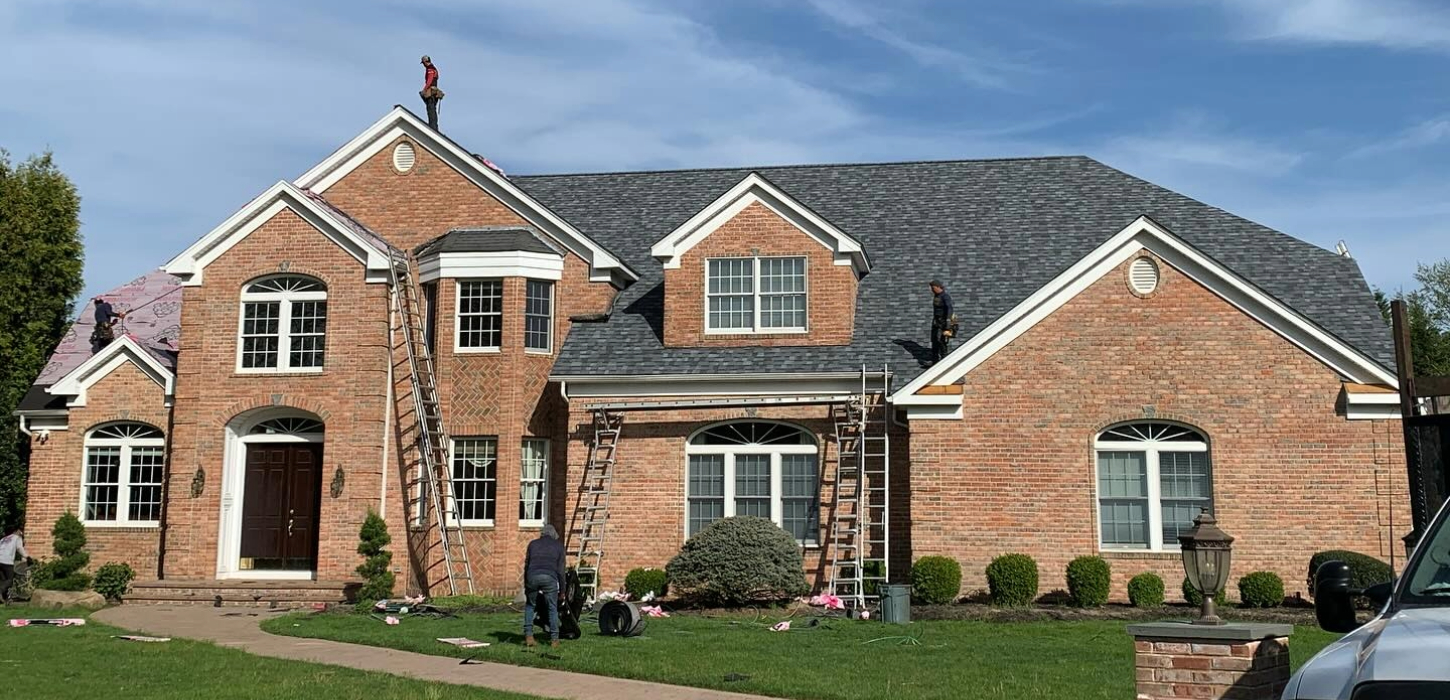
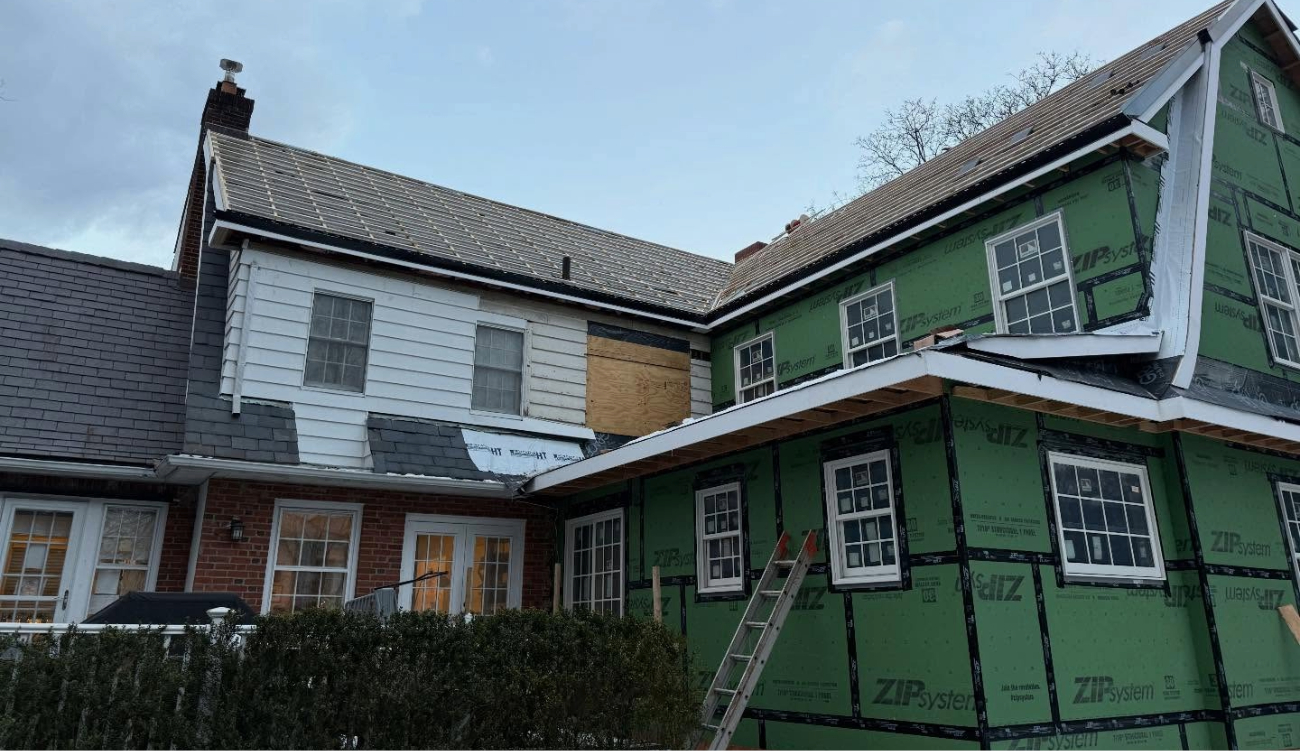
Our team has reinforced countless homes across the island; see our finished work to see why homeowners trust us.
Establishing a Regular Inspection Schedule
The foundation of any effective roof maintenance program is regular inspection. For Long Island homes, a professional inspection annually is the appropriate standard, ideally timed for either late spring after winter weather has passed or early fall before the winter season begins. Spring inspections reveal damage that developed during ice dam season, freeze-thaw cycling, and spring storms. Fall inspections confirm the roof is prepared for the demands of winter, which is when failures become most consequential.
What to Look for From the Ground
Between professional inspections, a visual assessment from the ground twice a year provides valuable early warning of developing issues. With binoculars or a camera with zoom capability, look for shingles that are missing, cracked, curling at the edges, or visibly darker than surrounding material, which can indicate moisture retention. Look for visible gaps or rust staining at flashing locations around the chimney, dormers, and any roof penetrations. Look for debris accumulation in valleys and around roof features. And look at the gutters for sagging sections, separations from the fascia, or visible blockage.
Attic Inspection
The attic should be inspected visually at least annually, ideally after a significant rain event. Look for any daylight visible through the roof deck, water staining on the underside of the sheathing, wet or compressed insulation, mold growth on wood surfaces, and any evidence of pest activity. An attic that smells musty or shows condensation on cold days has a moisture management problem that affects the roofing system’s longevity even if no active leak is present.
Gutter Maintenance: The Most Overlooked Connection to Roof Health
Gutters are so closely connected to roof performance that gutter maintenance is accurately considered part of roof maintenance. Clogged gutters that overflow direct water against the fascia and the lower course of shingles, creating exactly the moisture conditions that accelerate fascia rot and shingle deterioration. In winter, debris-clogged gutters contribute directly to ice dam formation by preventing meltwater from draining and allowing it to refreeze at the eaves instead.
Clean gutters twice per year as a minimum in Nassau County. The most critical cleaning is in late fall, after the majority of deciduous leaves have dropped but before freezing temperatures arrive. A second cleaning in spring removes winter debris. Beyond cleaning, inspect gutters for proper pitch, secure attachment to the fascia, sealed joints if you have a sectional system, and intact downspout extensions that direct water away from the foundation. A gutter that is clean but improperly pitched or inadequately attached is not performing its function and needs professional attention.
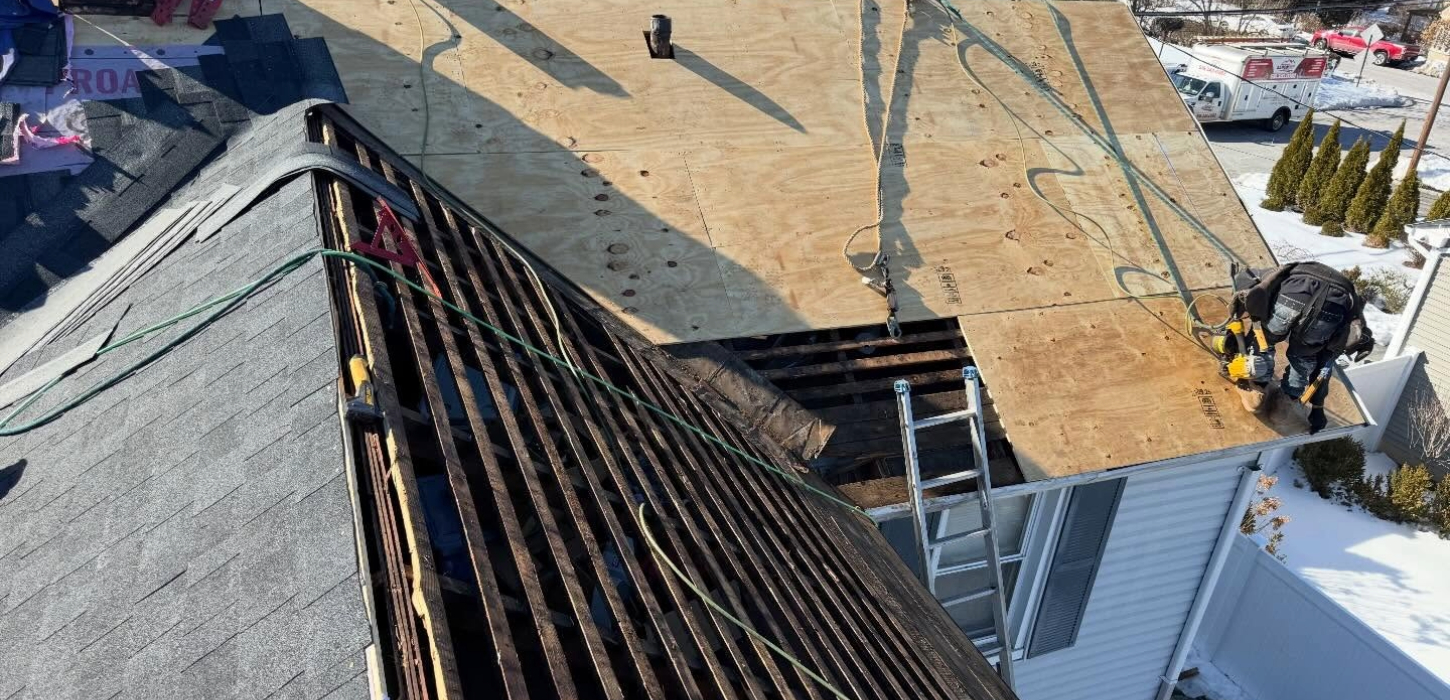
We follow a rigorous step-by-step safety protocol to ensure every repair is durable enough to withstand the elements.
Shingle Condition: What to Look for and When to Act
Shingle deterioration is the most visible form of roofing system aging, and recognizing the stages of that deterioration allows you to make informed decisions about timing repairs and replacement rather than reacting to failures after they have occurred.
Early Stage Deterioration
Granule loss is the earliest reliable indicator of shingle aging. The mineral granules embedded in asphalt shingles protect the underlying asphalt layer from UV degradation. As shingles age, they shed granules progressively. You will see this accumulation in your gutters and at the base of downspouts. Some granule loss is normal throughout a shingle’s life, but heavy accumulation after a few years of installation indicates a product quality issue, while heavy accumulation on a 15 to 20-year-old roof indicates approaching end of life.
Mid-Stage Deterioration
Curling and cupping of shingles indicate that the material has undergone significant thermal cycling and moisture exposure and is losing its structural integrity. Curled shingles cannot lay flat against the roof deck and cannot form the drainage barrier they are designed to create. Individual cracked shingles that are isolated and surrounded by intact material are candidates for replacement as spot repairs.
End-of-Life Indicators
When curling, cracking, and granule loss are visible across multiple sections of the roof simultaneously, the system is approaching the end of its useful life. Soft or spongy areas when walking the roof indicate decking damage beneath. Multiple areas of previous repair visible as mismatched shingles or surface sealant applications indicate a roof that has been patched repeatedly and is better served by full replacement than by additional repair investment.
Flashing Inspection and Maintenance
Flashing maintenance is one of the highest-value activities in a roof maintenance program because flashing failures cause a disproportionate share of roof leaks relative to the small percentage of the roof surface they occupy. Inspecting flashing visually during each ground-level assessment and attic inspection focuses attention on the areas most likely to develop problems.
What to Look for at Each Flashing Location
At chimney flashing, look for visible separation between the counter flashing and the chimney masonry, rust staining that indicates corrosion, or caulk that has dried and pulled away from the joint it was covering. At pipe boot flashings, look for cracking or separation of the rubber collar from the pipe. At step flashing locations along dormers and walls, look for lifted or missing individual pieces and for staining on the exterior wall below the flashing line that indicates water has been running behind the flashing. At valley intersections, look for deteriorated or lifted valley material and for shingles at the valley edge that show granule loss faster than surrounding areas.
Minor sealant failures at specific points can be addressed with high-quality roofing sealant as a maintenance repair. Structural flashing failures, where the metal itself has corroded, lifted away from the surface, or separated significantly from the chimney mortar, require professional repair that replaces the flashing material rather than applying sealant over a structural failure.
Attic Ventilation and Insulation: The Hidden Roof Performance Factors
Attic ventilation is one of the most important and least discussed aspects of roof maintenance. A properly ventilated attic maintains temperatures closer to outside ambient levels, which produces two critical benefits. In summer, it prevents excessive heat buildup that bakes shingles from below, accelerating granule loss and shortening their service life. In winter, it prevents the warm attic air that causes the snow-melt cycle responsible for ice dam formation.
The standard recommendation is one square foot of net free ventilation area for every 150 square feet of attic floor space, balanced between intake at the soffits and exhaust at or near the ridge. If your attic runs significantly hotter than outside ambient temperature in summer, or if you consistently develop ice dams in winter despite having an otherwise adequate roof, attic ventilation and insulation assessment should be part of your roof maintenance review. At Aaron Roofing Corp, our roof inspections include an assessment of attic conditions specifically because ventilation issues affect roof performance and longevity.
Tree and Vegetation Management
Long Island’s residential neighborhoods are characterized by significant tree canopy that creates real roofing maintenance implications. Trees provide shade that reduces summer cooling costs and contributes to property aesthetics, but branches that extend over the roof create a set of specific risks that require management as part of a roof maintenance program.
Overhanging branches deposit leaves and organic debris directly onto the roof surface rather than to the ground. This debris accumulates in valleys and around roof features, retaining moisture and promoting biological growth including algae and moss. During wind events, branches flex and contact the roof surface, abrading shingles and accelerating granule loss in the contact areas. In severe events, branches can break and cause significant impact damage. Keeping overhanging branches trimmed back from the roof surface, maintaining a clearance of at least six feet, reduces all of these risks simultaneously. Large trees adjacent to the home should be assessed periodically by an arborist for structural health, as a failing tree represents a catastrophic roofing risk that goes beyond the scope of ordinary maintenance.
Post-Storm Inspection Protocol
Long Island’s storm calendar includes nor’easters, occasional tropical systems, and summer convective storms with high winds and hail. Each significant weather event is an occasion for a post-storm roof assessment. The good news is that this does not require getting on the roof after every storm. A systematic ground-level inspection combined with an attic check captures most storm damage indicators without the safety risk of a wet roof assessment.
After any wind event, walk the property and look for shingles, flashing pieces, or gutter sections on the ground. Inspect the gutters for impact debris or displacement. From the ground, look for areas of the roof where the shingle pattern has been disrupted. After hail events, check horizontal surfaces including air conditioning units, window sills, and garage doors for impact marks. Hail that dents these softer surfaces has likely impacted shingles as well, even if the impact is not immediately visible from the ground. After significant storm events, scheduling a professional inspection before filing an insurance claim ensures the damage is fully documented and the claim accurately reflects the scope of what occurred.
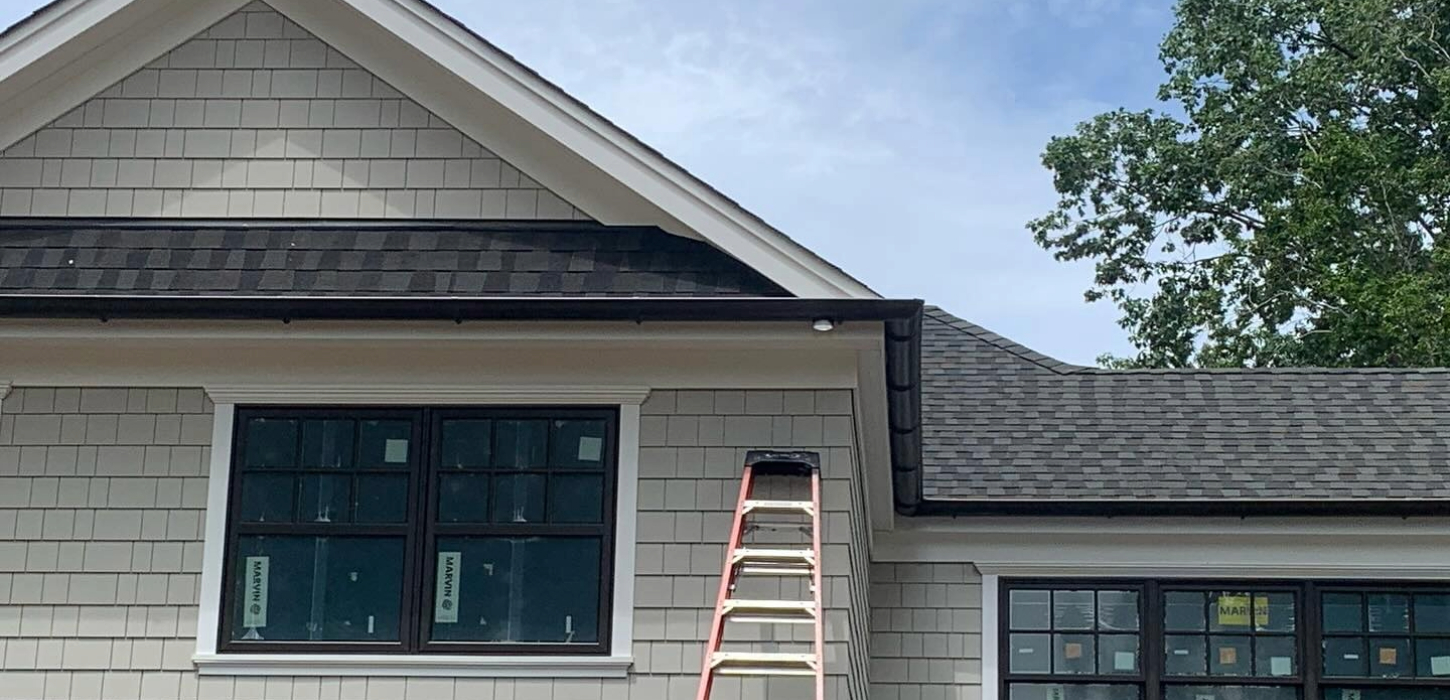
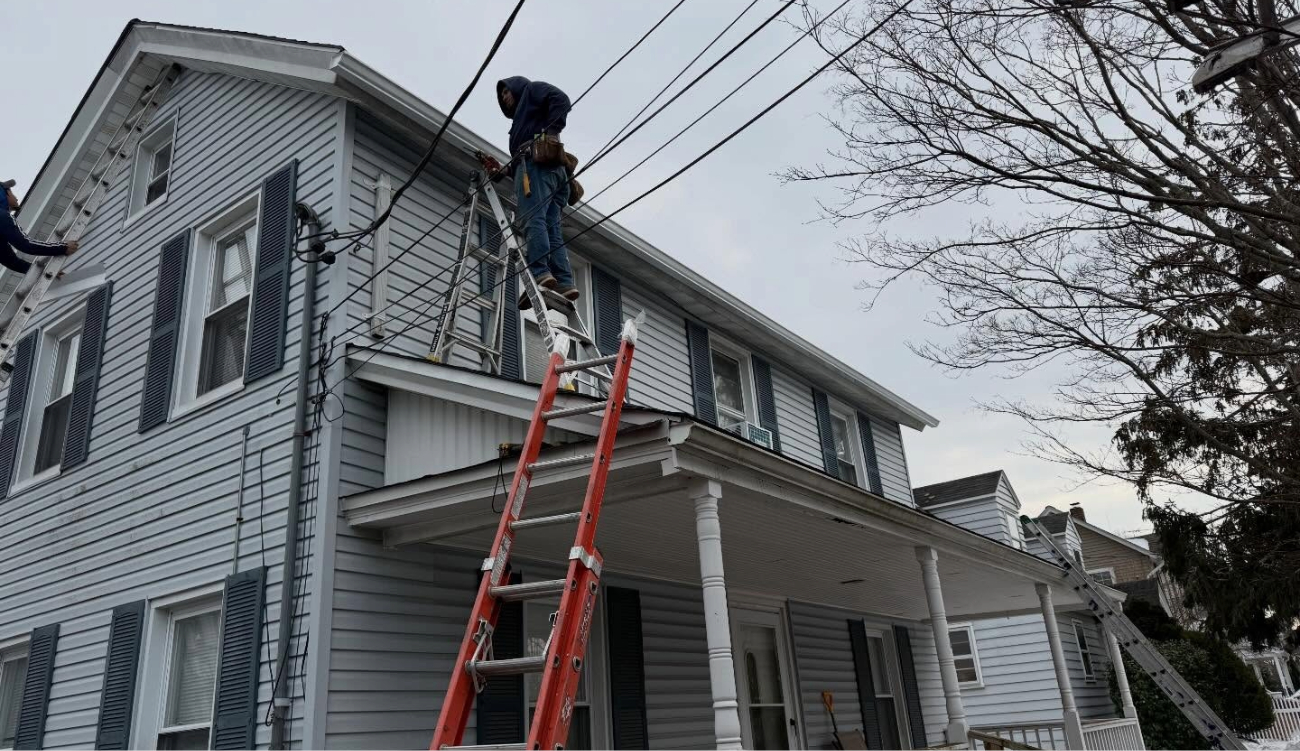
Our team has reinforced countless homes across the island; see our finished work to see why homeowners trust us.
Frequently Asked Questions
How often should I have my roof professionally inspected on Long Island?
Once per year is the appropriate standard for most Long Island homes, with an additional inspection after any significant storm event. The annual inspection is best timed for either late spring, when winter damage is fully revealed and the roof can be assessed before summer heat begins, or early fall, when you want confirmation that the roof is prepared for winter’s demands. Homes with older roofing systems or those that have experienced repeated repair work benefit from more frequent inspection to monitor developing conditions before they produce failures.
What is the biggest mistake Long Island homeowners make with their roofs?
Waiting too long to address visible warning signs is the most common and most costly mistake. A missing shingle, a visible flashing separation, or interior water staining are all signs that action is needed immediately. Each rain event and weather cycle that passes between the warning sign and the repair is an opportunity for the damage to expand. A $300 flashing repair that is deferred for a season can become a $3,000 decking and repair project by the time the water damage has fully developed. The most effective roof maintenance decision a homeowner can make is taking visible warning signs seriously and getting professional eyes on the problem within days rather than weeks or months.
Does cleaning my roof damage the shingles?
Roof cleaning done correctly using a low-pressure soft wash approach with appropriate cleaning solutions does not damage shingles. High-pressure washing, however, can drive water under shingle laps, strip granules, and void manufacturer warranties. If you are dealing with significant algae or moss growth on your roof, which is common in shaded areas of Long Island homes, a soft wash treatment using a diluted bleach solution or a commercially formulated roof cleaning product applied at low pressure is the appropriate method. Allow it to work and rinse naturally with rainfall rather than pressure washing it off. Some manufacturers offer algae-resistant shingles with copper-based granules that inhibit biological growth as a proactive measure for homes with persistent algae issues.
How do I know if my attic ventilation is adequate?
Several indicators suggest inadequate attic ventilation. In summer, an attic that feels dramatically hotter than the outside temperature when you open the access hatch indicates insufficient exhaust ventilation. In winter, heavy frost or condensation on the underside of the roof sheathing when you inspect with a flashlight during cold weather indicates warm humid air from the living space is entering the attic and condensing on cold surfaces, which means both insufficient ventilation and likely insufficient insulation at the attic floor. Ice dams that form consistently every winter after snowfall, particularly on a roof that is otherwise in good condition, point strongly to an attic that is too warm relative to the outside temperature. A professional inspection that includes attic assessment is the most reliable way to evaluate ventilation adequacy.
What is the expected lifespan of an asphalt shingle roof on Long Island?
Standard three-tab asphalt shingles are typically rated for 15 to 20 years and often reach those limits in Long Island’s climate. Architectural or dimensional asphalt shingles are rated for 25 to 30 years, though real-world performance in the Northeast often lands toward the lower end of that range due to the weather stresses the region delivers. Impact-resistant shingles with higher wind and hail ratings are available and perform better under Long Island’s wind and storm conditions. The quality of the original installation, the attic ventilation conditions, and the consistency of maintenance all influence how closely a specific roof reaches its rated lifespan. Roofs that receive proactive maintenance consistently outlast those that do not by a meaningful margin.
Small Habits, Big Protection
Consistent roof maintenance is one of the highest-return activities available to a Long Island homeowner. The investment in regular inspections, gutter cleaning, and prompt attention to minor issues is modest. The return is a roofing system that performs reliably for its full expected lifespan rather than one that develops expensive failures prematurely because developing problems went unaddressed through too many seasons of weather exposure.
Aaron Roofing Corp serves homeowners across Long Island with professional roofing services and free inspections performed by a fully licensed and insured team. Our owner is actively involved on every project, ensuring quality workmanship and honest communication from start to finish. Whether you need a routine inspection, a specific repair, or guidance on the condition of your roofing system, we are ready to help with no obligation and no pressure.
Contact Aaron Roofing Corp today at 516-343-0382 or visit aaronroofingcorp.com to schedule your free roof inspection. The best time to address a developing roofing problem is before it becomes an urgent one.